
AI Prompt to generate an AI-native enterprise software architecture diagram
Prompts for generating diagrams comparing traditional vs AI-native enterprise architectures.
Sample diagrams as inspiration:
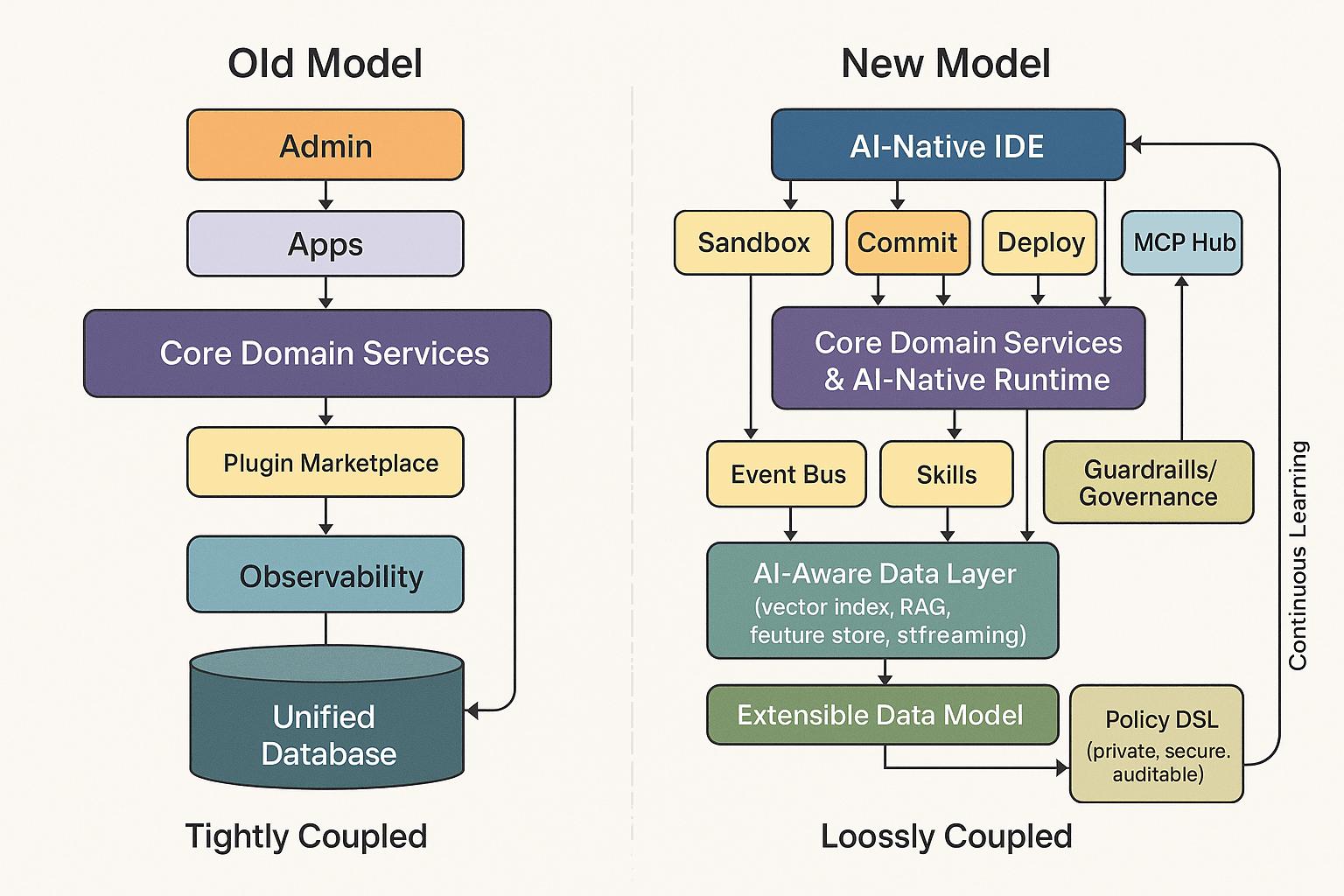
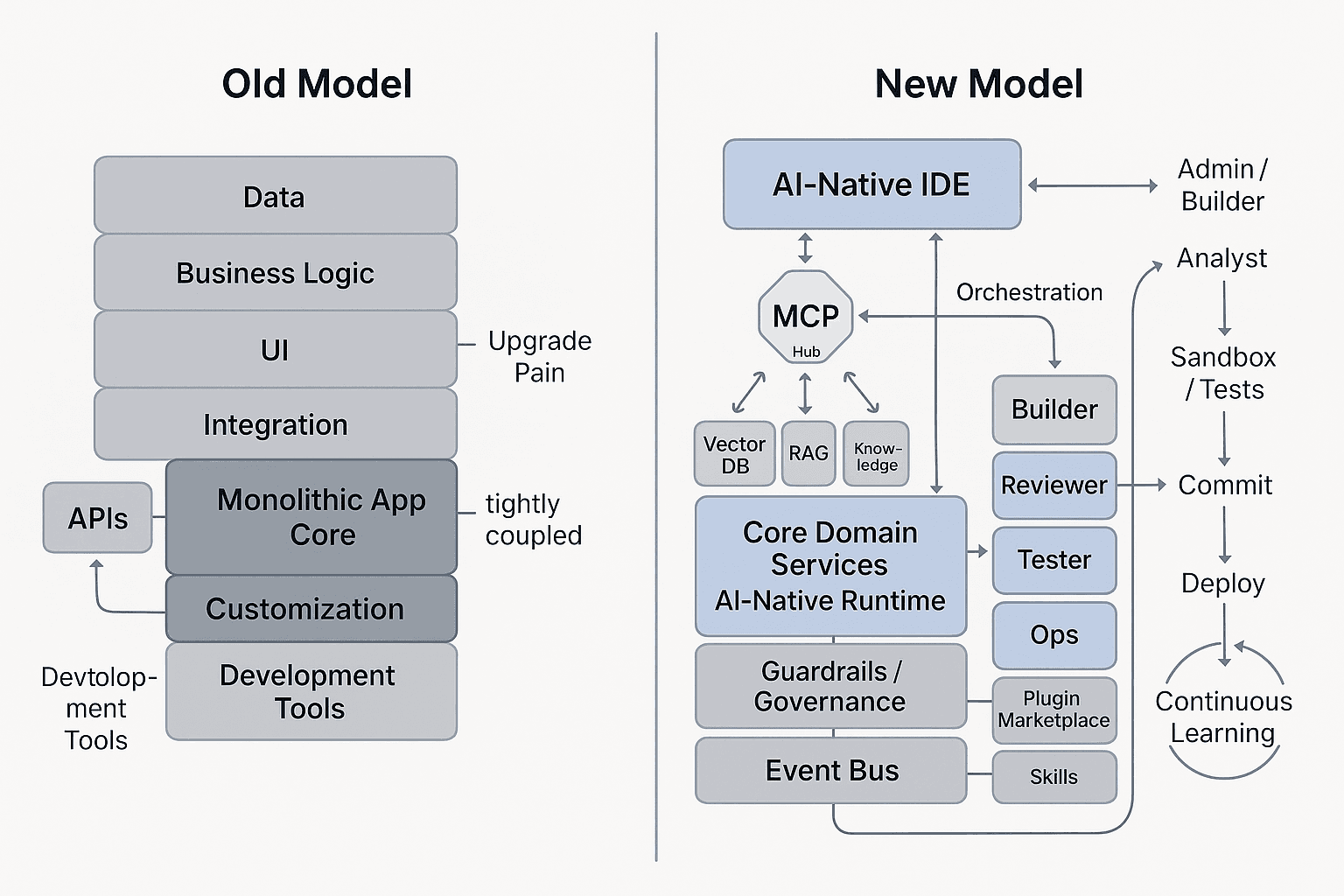
Diagram overview
- Extensible Data Model (explicit layer)
- Unified Database connection through an AI‑Aware Data Layer (vector index, RAG, feature store, streaming)
- Core Business Logic in Natural Language with a secure private Policy DSL for modifiable rules
- MCP hub + agents remain, with guardrails/governance and a continuous-learning loop
Old model (left)
-
App layers (top→down): UI → Business logic → Integration bus/ETL → Customization scripts/SDK → Monolithic app core.
-
API box: REST/SOAP APIs (narrow surface), placed off to the side; arrow back into the core to imply platform constraints.
-
Data boxes: Operational RDBMS → nightly ETL → separate data warehouse/BI (data copies).
-
Coupling callouts:
- Tight coupling: UI, logic, integration, and data bound to vendor core.
- Plugin marketplace (fragile): version drift, vendor upgrade breaks.
- Upgrade pain: vertical bracket spanning UI→core→DB.
- Multi-DB sprawl: app DBs + shadow spreadsheets.
-
Governance/ops (small boxes at bottom): manual release pipeline, change tickets, auditor after-the-fact.
Optional clarifiers to add
- Siloed identities/roles.
- Limited test automation; change windows required.
- Observability after deployment, not at design time.
New model (right)
-
Top swimlane: Design-time
- AI-native IDE (prompt chat + diff view + code/flow editor).
- MCP hub (Model Context Protocol) connecting tools, data, and services.
- Agent mesh: Builder, Reviewer, Tester, Ops (policy-constrained).
- Sandbox/tests → commit → deploy arrows; feedback loop back to IDE.
-
Core runtime block: Core domain services + AI-native runtime
- Natural-language business logic (compiled to flows/code) side-by-side with a private, secure, auditable Policy DSL.
- Guardrails/governance: policy engine, RBAC/ABAC, PII redaction, content filters, allow/deny tools.
- Event bus for everything (domain events, audit events).
- Skills/plugin marketplace (versioned, signed, hot-swappable).
-
Data plane (attach visually beneath core)
- AI-aware data layer: vector index + RAG, feature store, streaming/logs, time-series, document store.
- Unified operational + analytical database (HTAP/lakehouse) feeding both app and AI features.
- Extensible data model: schema registry, knowledge graph option, data products with contracts.
- LLM/AI gateway: routing, model selection, safety, cost/latency policies.
-
Trust boundaries (thin dashed boxes)
- Tenant boundary: per-tenant data + policies.
- Model boundary: third-party models vs. private foundation models.
-
Observability everywhere
- Design-time telemetry (prompt/agent traces), runtime traces/metrics/logs, evals, drift monitors.
-
Continuous learning loop
- User actions → evals → fine-tuning/heuristics → policy updates → regenerated artifacts with approvals.
Terminology
- Extensible data model → Extensible data model / knowledge graph (use both if you want emphasis).
- AI-aware data layer → LLM/AI gateway + AI-aware data layer (two boxes: gateway sits above).
- Unified database → Unified operational + analytical store (HTAP/lakehouse).
- Policy DSL → Private policy DSL (secure, auditable, compilable), with a small example bubble:
- “When record contains PHI and requester is not in CareTeam, mask fields X/Y/Z.”
- MCP hub → MCP hub (tools, data, model routers) with thin lines to IDE, agents, gateway, and data layer.
- Agent mesh → Agent mesh (builder/reviewer/tester/ops) with badges showing scopes granted by policy.
Legend (bottom or side)
- Solid arrows: synchronous calls.
- Dashed arrows: orchestration/approvals.
- Dotted arrows: telemetry/evals.
- Lock icon: trust boundary.
- Diamond icon: policy decision points (allow/deny/tool-use).
- Color hinting: design-time (cool), runtime (neutral), data plane (warm), governance (accent).
Side-by-side one-liners
- Old: “Configuration-heavy, code-light… until you need something real → then brittle custom code bound to the core.”
- New: “Intent-first, policy-safe extensibility: natural language + DSL → reproducible code/flows with guardrails.”
Generate the diagram with:
- knowledge graph added to the data model
- LLM/AI gateway separated from the AI-aware data layer
- explicit trust boundaries
- example Policy DSL bubble
- a compact legend in the footer
How is this guide?
Last updated on