
AI Context Playbooks – ChatGPT 5 Prompt Reskilling
Prompt engineering templates and guides to help teams adapt their workflows for ChatGPT 5's multi-model routing capabilities.
👉 Please sure to read OpenAI GPT-5 prompting guide first.
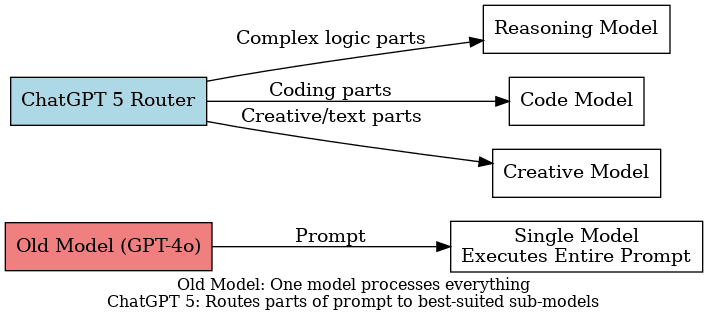
With the release of ChatGPT 5, OpenAI has introduced a multi-model routing capability - meaning that your prompt is no longer sent to a single fixed model. Instead, ChatGPT 5 dynamically routes different parts of your request to the most appropriate underlying model (including GPT-4o and other specialized sub-models) based on the nature of the task.
While this makes ChatGPT 5 more powerful and adaptive than GPT-4o, it also changes the way we must approach prompt writing:
- Model choice is implicit – ChatGPT 5 decides which sub-model to use based on your instructions, so the clarity and specificity of your prompts directly influence whether the best sub-model is selected.
- Role- and task-specific framing has a much greater effect on quality and speed of output.
- Context density (the right amount of relevant detail without clutter) matters more, because the router uses that context to determine optimal reasoning and style.
- Output specification is critical - defining the deliverable format and constraints helps ChatGPT 5 select specialized reasoning or generation paths.
For teams already comfortable with GPT-4o, this means reskilling in prompt design to fully leverage ChatGPT 5’s adaptive capabilities. Old habits like generic or underspecified prompts will not consistently yield the best results.
Purpose of This Directory
The ai-context-playbooks/chatgpt5-skills directory contains reusable prompt engineering templates to help engineers, business staff, and domain specialists rapidly adapt their workflow for ChatGPT 5.
The goal is to:
- Accelerate adoption of ChatGPT 5’s multi-model routing advantages.
- Reduce trial-and-error by giving staff structured, high-quality prompt starting points.
- Enable role-specific mastery - ensuring prompts are tailored to sales, marketing, product, engineering, QA, DevOps, and more.
- Support side-by-side model usage - helping users know when to prefer ChatGPT 5 vs. GPT-4o for a given task.
Files in This Directory
1. [chatgpt5-meta-template.prompt]
A meta-prompt generator for creating tailored ChatGPT 5 vs. GPT-4o prompt guidance for any use case.
What it does:
- Lets you fill in placeholders for use case, role, output goal, and constraints.
- Produces side-by-side prompt templates optimized for ChatGPT 5 and GPT-4o.
- Suggests usage tips and when to prefer one model over the other.
- Generates illustrative example outputs for both models.
When to use it:
- When you have a new use case and want to quickly develop best-practice prompts for both models.
- As a teaching tool for onboarding staff into ChatGPT 5 prompt thinking.
2. [chatgpt5-role-examples]
A set of pre-filled meta-prompts for the most common roles in our organization:
- Sales – Lead Nurturing Email Sequence
- Marketing – LinkedIn Campaign Messaging
- Product Definition – PRD Creation
- Software Architecture – System Design
- QA – Automated Test Plan Generation
- DevOps – CI/CD Pipeline Design
What it does:
- Provides ready-to-run prompt guidance for each role.
- Encodes best practices for ChatGPT 5’s routing behavior vs. GPT-4o’s direct execution.
- Acts as a “prompt playbook” for role-specific excellence.
When to use it:
- When you want to skip placeholders and start from a working example.
- For internal training sessions and prompt review workshops.
How to Use
-
Start with the meta-template (
chatgpt5-meta-template.prompt) when exploring a new use case. Fill in the placeholders and run the meta-prompt to produce optimized instructions for both ChatGPT 5 and GPT-4o. -
Refer to the role examples (
chatgpt5-role-examples) when your task matches one of the covered roles. Use them directly or modify slightly for your context. -
Iterate – Feed back the output into ChatGPT for refinement.
ChatGPT 5 is designed for interactive improvement loops; don’t settle for the first draft.
Why This Matters
Without deliberate prompt reskilling:
- Users may unintentionally get suboptimal routing in ChatGPT 5, leading to slower or less relevant responses.
- Teams may default to GPT-4o for speed, missing the richer reasoning and cross-domain synthesis ChatGPT 5 can deliver.
- Cross-functional collaboration can suffer if prompts aren’t standardized and role-aware.
These playbooks are designed to make high-performance prompting a repeatable skill, so we can consistently get the best results from both ChatGPT 5 and GPT-4o.
Next Steps
- Schedule a prompt training workshop to walk through these playbooks with your team.
- Encourage each department to maintain its own prompt library built on this structure.
- Continuously update prompts as ChatGPT 5 routing behavior evolves.
How is this guide?
Last updated on
AI as a Colleague, Not a Tool
Why treating AI as a colleague rather than a tool transforms organizational capability and creates lasting competitive advantage.
Tips, tricks, and key differences between ChatGPT 5 vs 4o
Compare ChatGPT 5's routing and reasoning capabilities against GPT-4o, plus ready-to-use prompt templates for business and engineering roles.