
Project Managers & QA: Simulating UAT in Legacy Apps with AI Prompts to Shift Left
Simulating UAT in legacy apps with AI prompts to transform PMs and QA from coordinators to ICs.
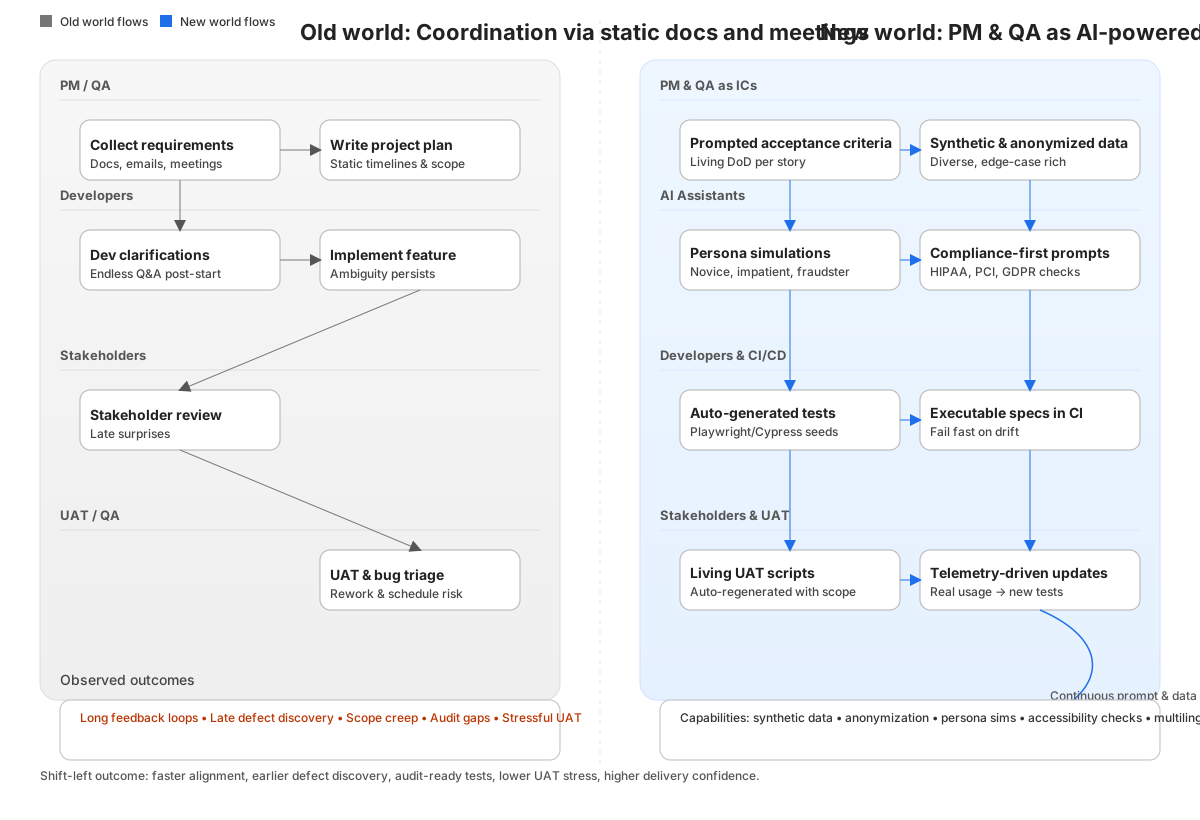
In the traditional software lifecycle, project managers (PMs) and quality assurance (QA) leaders are positioned downstream from developers. They collect requirements, schedule reviews, and plan for user acceptance testing (UAT) long after code is written. This sequencing often causes friction: developers demand clarity after development has already begun, while PMs and QA scramble to translate business needs into usable acceptance criteria and test cases.
AI changes the game. With generative models, PMs and QA can simulate user journeys, craft synthetic data, and generate living UAT scenarios before a line of code is written. This transforms PMs and QA leaders from coordinators to individual contributors (ICs) who shape development inputs as much as developers do. It’s the embodiment of “shifting left”: embedding testing and user validation into the earliest phases of design and planning.
Old World vs. New World
Old World
- Requirements live in static documents and tickets.
- PMs spend meetings clarifying scope instead of validating user journeys.
- QA builds test cases late, often from ambiguous or incomplete specifications.
- Bug reports rely on screenshots, email threads, and “steps to reproduce.”
- Developers ask endless clarifying questions after work begins.
New World
- PMs and QA leaders become AI-powered simulation engineers.
- They write prompts to generate acceptance criteria, UAT scenarios, and even mock user dialogue.
- AI simulates realistic users (novices, experts, error-prone customers) and stress tests requirements before dev starts.
- Test cases are living, auto-updated artifacts that evolve alongside the product.
- Developers receive requirements packaged with executable tests and example data.
Strategies for AI-Augmented PM & QA Collaboration
1. Prompt-Driven Acceptance Criteria
Instead of static Gherkin-style acceptance criteria, PMs can use AI prompts to explore hundreds of “what if” scenarios.
Example Prompt:
“Given a logged-in user with insufficient funds, what UI errors should appear when attempting to buy a $50 item? Include JSON error payloads, button states, and retry options.”
Output:
- Error modal: “Your account balance is too low.”
- JSON:
{ code: 402, message: "Payment Required" } - Retry options: “Add Funds,” “Change Payment Method.”
Stakeholders see exactly what the customer experience looks like, aligning design, development, and QA around the same narrative.
2. Synthetic Data Generation for Early Testing
PMs and QA leaders can generate realistic but anonymized data sets to unblock developers early.
- AI can create diverse customer profiles (e.g., international names, varied currencies, accessibility needs).
- Edge cases like invalid addresses, maximum field lengths, or corrupted files can be injected automatically.
- Customer-provided data can be anonymized through AI-assisted scrubbing, enabling realistic test environments without compliance risk.
Unobvious Example: Before building a healthcare app, QA could generate thousands of synthetic patient records, including edge cases like conflicting lab results or mis-typed dates of birth. Developers see real-world messiness early, avoiding brittle implementations.
3. User Simulations as Virtual UAT
Generative AI can act as different personas during sprint planning:
- The distracted user: forgets steps, closes the app mid-transaction, misreads instructions.
- The malicious actor: tries SQL injection in text fields, manipulates API calls.
- The impatient customer: retries actions quickly, generating race conditions.
Example:
“Act as a distracted user completing online checkout. Insert mistakes (typos, wrong addresses, closing the browser early). Report how the system should react.”
Developers gain instant exposure to edge cases that would normally appear only in late-stage UAT.
4. AI-Powered “Living” Test Plans
Instead of static checklists, PMs can maintain prompts that regenerate test plans dynamically whenever requirements shift.
- Linking Jira/Linear issues with AI prompts ensures test cases evolve with scope changes.
- Each story automatically includes a “definition of done” written as a test prompt.
- AI can convert these into automated test scripts (e.g., Playwright, Cypress) without waiting for QA engineers to hand-code them.
5. Early Compliance and Policy Embedding
PMs can prompt AI to integrate regulatory and compliance requirements directly into UAT scenarios:
- HIPAA: Verify that PHI is masked in logs.
- PCI-DSS: Simulate invalid credit card flows.
- GDPR: Ensure “Delete Account” requests cascade to all systems.
This ensures that compliance tests are built from day one, reducing audit pain later.
6. PMs and QA as ICs (Individual Contributors)
The biggest mindset shift: PMs and QA leads are no longer just facilitators. They actively create inputs that shape code.
- PM as IC: Crafts acceptance criteria, prompts AI to simulate requirements, curates examples for developers.
- QA as IC: Generates synthetic datasets, produces automated test scripts, validates compliance edge cases.
Both become first-order contributors to the product’s technical assets-alongside developers.
Obvious vs. Non-Obvious Applications
Obvious:
- Writing automated regression tests.
- Drafting UAT scripts for end-user testing.
Non-Obvious & Innovative:
- Gamified UAT simulations: AI creates roleplay scripts where users “compete” to find edge cases.
- Multilingual test coverage: Generate UAT in every supported language to uncover localization issues.
- Accessibility-first prompts: Simulate how a visually impaired user would navigate via screen reader.
- Failure-chain modeling: Ask AI to simulate cascading failures (e.g., payment API fails → retries → database lock → degraded UX).
- Persona spectrum testing: Create test cases for impatient users, tech-illiterate customers, or fraudsters.
Why This Matters
-
Cuts Feedback Loops in Half Developers don’t wait weeks for QA input. They receive executable, AI-generated acceptance criteria at sprint planning.
-
Improves Coverage and Creativity AI can imagine failure modes and user behaviors humans overlook.
-
Builds Alignment PMs, QA, and developers collaborate around the same living prompts, not siloed documents.
-
Elevates PMs & QA Roles They shift from being coordinators to hands-on contributors-co-creators of the product experience.
Call to Action
For organizations ready to embrace AI-first software engineering, the next step is cultural: recognize PMs and QA leaders as builders, not just managers. Provide them tools, AI budgets, and training to craft prompts and simulations that bring UAT forward in the lifecycle.
When PMs and QA teams simulate before developers build, the definition of done is no longer debated at the end-it is embedded from the beginning. That’s how projects shift left, reduce defects, and accelerate delivery without sacrificing quality.
How is this guide?
Last updated on
Project Managers & QA: Shifting Left in AI Apps with Data Integration, Cleansing, and Chatbots
How PMs and QA leaders use AI to simulate integrations, prototype data cleansing rules, and generate chatbot behaviors.
PM & QA Shift-Left Checklist
Move from coordinators to ICs by producing executable inputs before development starts.